What does IRF4 do?
 Emily Phillips
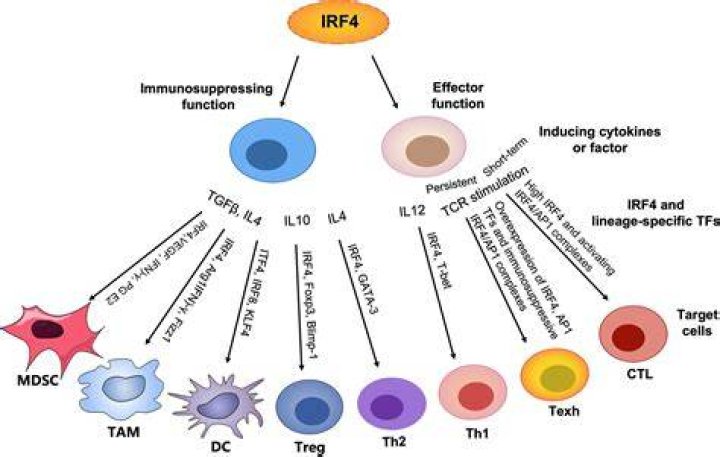
 IRF4 was identified as a key factor with essential functions in lymphocytes, where it directs the development, affinity maturation, and terminal differentiation of B cells and has critical roles in diverse effector T cells.
What does the IRF4 gene determine?
“IRF4 is involved in regulating production and storage of melanin, the pigment that determines hair, skin and eye color,” the scientists said.
Is IRF4 a transcription factor?
IRF-4 is a member of the interferon regulatory factor (IRF) family of transcription factors, which were first identified as being involved in the expression of interferon-induced genes.
What chromosome is IRF4 on?
IRF4 (interferon regulatory factor 4)
| Alias (NCBI) | IRF-4 |
|---|---|
| Local_order | IRF4 is located on chromosome 6 at the telomeric extremity of the short arm, and lies between the DUSP22 (dual specificity phosphatase 22) and EXOC2 (exocyst complex component 2) genes. |
What is c-Myc function?
c-Myc is a multifunctional transcription factor which drives the multiple synthetic functions necessary for rapid cell division while at the same time inhibiting expression of genes with antiproliferative functions. Because of its propensity to induce apoptosis, its expression is tightly regulated.
What kind of gene is SOX2?
SOX2 (SRY-Box Transcription Factor 2) is a Protein Coding gene. Diseases associated with SOX2 include Microphthalmia, Syndromic 3 and Septooptic Dysplasia.
What is the function of IRF4 gene?
In melanocytic cells the IRF4 gene may be regulated by MITF. IRF4 is a transcription factor that has been implicated in acute leukemia. This gene is strongly associated with pigmentation: sensitivity of skin to sun exposure, freckles, blue eyes, and brown hair color.
Is interferon regulatory factor 4 (irf-4) useful in skin biopsies?
Interferon regulatory factor 4 (IRF-4) targets IRF-5 to regulate Epstein-Barr virus transformation. Support the clinical utility of FISH for IRF4 in the differential diagnosis of T-cell lymphoproliferative disorders in skin biopsies, with detection of a translocation favoring cutaneous anaplastic large cell lymphoma.
Does IRF4 play a role in cutaneous squamous cell carcinoma development?
Study confirmed a significant role for IRF4 rs12203592 and SLC45A2 rs16891982 in the risk of cutaneous squamous cell carcinoma development in organ transplant recipients. IRF4 is overexpressed in human non-small cell lung cancer and activates the Notch signaling pathway.
Is interferon regulatory factor 4 (IRF4) involved in Hodgkin’s lymphoma?
MUM1/IRF4 is expressed in most cases of classical Hodgkin’s lymphoma and shows that lack of this expression in a minority of cases may be a potential adverse prognostic factor. Possible involvement of interferon regulatory factor 4 (IRF4) in a clinical subtype of adult T-cell leukemia.