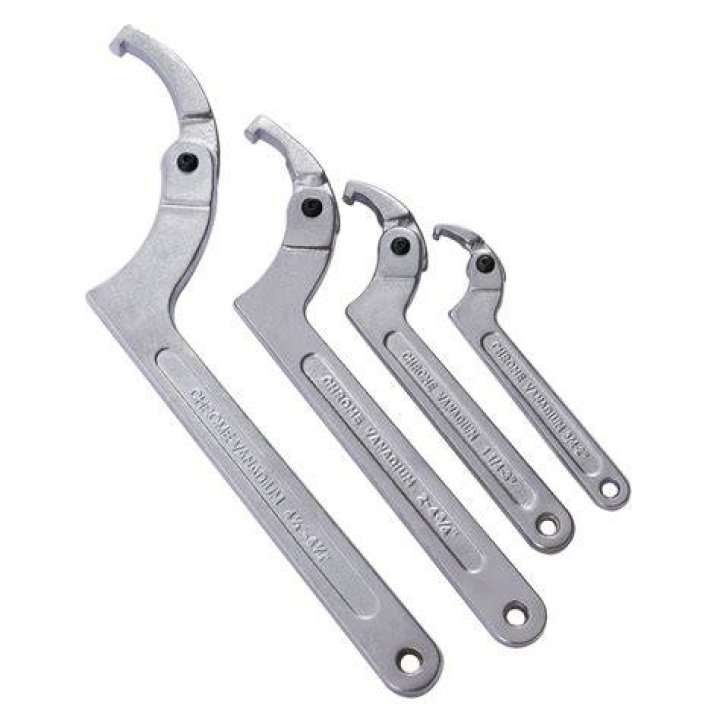
What is a pin spanner wrench used for?
 Mia Tucker
 The lock nuts used for attaching abrasive grinding pads to grinder power tools are called pin spanners. The moving pins cause the fastener to move when the wrench is turned.
How does a pin spanner work?
Rather than gripping the head of a fastener around the outside, they grip the fastener by inserting two metal pins into special holes in the fastener head. When the spanner is turned, the moving pins cause the fastener to move too. Pin spanners come in a few designs that all achieve the same results.
What are C spanners used for?
C Spanners are typically used in the industrial and automotive industry for tightening and loosening nuts or bolt heads and adjusting slotted retaining rings.
How do you identify a spanner?
Spanner. The width across flats indicates the “size” of the spanner. It is imprinted on the spanners in millimeter (mm) values. Older British and current US spanners (wrenches) have inch sizes that are imprinted in intermediate sizes in fractions.
How do you use a spanner wrench?
A spanner or wrench is used for turning a nut, bolt or similar fixing that is turned to tighten. The spanner is used to grip the given fixing (whether it is a nut, bolt, concrete screw etc….) and turn it, allowing you to apply torque and tighten the nut onto the bolt.
Is there a standard spanner wrench?
To be more specific, there are approximately 18 different standard sizes for a spanner wrench. You might be surprised to learn the information that is provided in the list of spanner sizes below. Spanner Wrench Standard Sizes: MQ.6 or 5/32″ (3.2mm) M2 or 3/16″ (4mm) M2.5 or 1/4″ (5mm) M3 or 5/16″ (5mm) M3.5 or 11/32″ (6mm) M4 or 3/8″ (7mm)
Are spanner wrenches Universal?
While it is true that the traditionally shaped spanner wrench is not necessarily universal for every task you can think of, there are special spanner wrenches that can be interchangeable for any purpose.
What is a Grip Wrench?
A wrench or spanner is a tool used to provide grip and mechanical advantage in applying torque to turn objects—usually rotary fasteners, such as nuts and bolts—or keep them from turning. In Commonwealth English (excluding Canada), spanner is the standard term.


