What is joint attention intervention?
 Mia Tucker
 Children engage in joint attention to interact with another person about an object or event in their environment (Mundy & Crowson, 1997), conveying the message, “Look with me at this interesting object or event.” This interaction involves the adult commenting about the object or event (e.g., “Yes, that’s a doggy!”) and …
How do you explain joint attention?
When one person purposefully coordinates his or her focus of attention with that of another person, we refer to the behavior as “joint attention.” Joint attention involves two people paying attention to the same thing, intentionally and for social reasons.
What is an example of joint attention?
A child can exhibit joint attention by responding or initiating. An example of a response would be if a parent and a child are playing together and the parent says, “Look at the puppy!” The child responds by following the parents gaze and point, and looks at the puppy.
What is a joint attention classroom?
Joint attention is vital to language development and early word learning. It refers to the shared attention between two people and a third object or event. The attention shifts between the object and the other person, and both persons are aware that attention to the third object is shared.
What is joint attention and why is it important?
Joint attention involves sharing a common focus on something (such as other people, objects, a concept, or an event) with someone else. It requires the ability to gain, maintain, and shift attention. For example, a parent and child may both look at a toy they’re playing with or observe a train passing by.
What is the role of joint attention in early word learning?
Joint attention – parents’ and children’s coordinated attention to each other and to a third object or event – is believed to play a causal and critical role in early word learning. Thus, the assumption that joint attention is a necessary and sufficient precursor to vocabulary learning is not universally supported.
How do you teach joint attention?
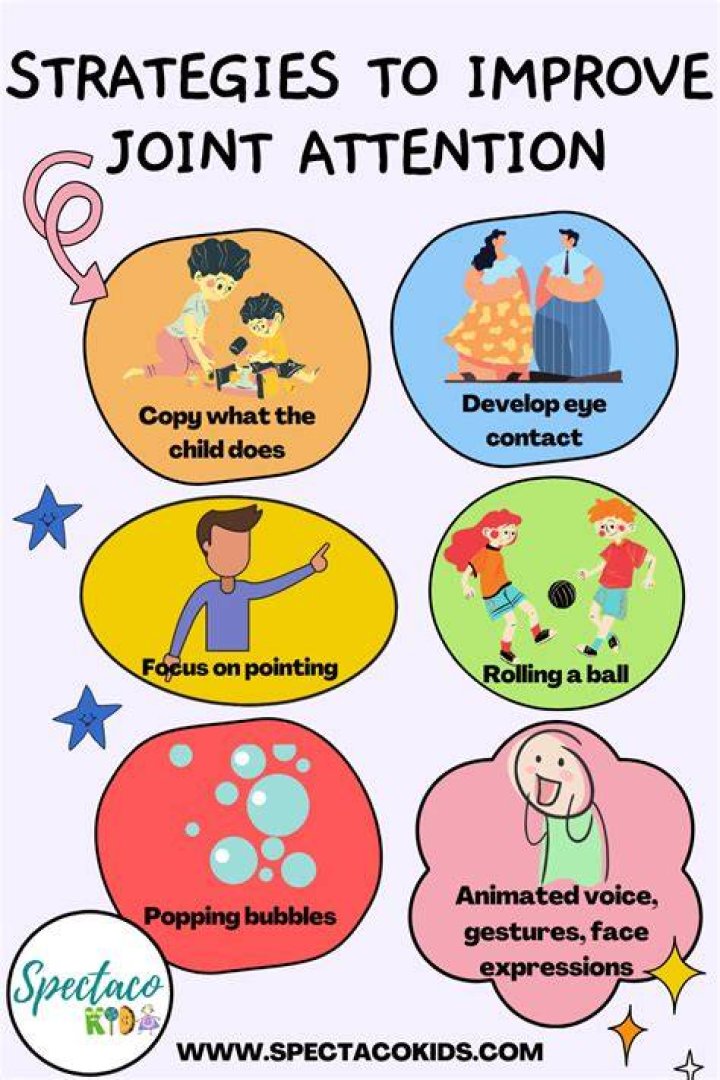
Some ways to increase joint attention include:
- Play or sit directly opposite to your child.
- Position yourself to gain eye contact and lots of smiles.
- Assist focus on your face by using hats, sunglasses, stickers, etc.
- Use cause and effect toys in play.
- Use an animated voice and facial expressions.
How do I teach my child joint attention?
– Focus on pointing. Teach your child to comment (this is one way joint attention is initiated) by encouraging him/her to point to show an object of interest. Example: There is a toy truck. Shape the child’s fingers into a point, touch his/her pointed finger to the truck, and say “truck!”
What is joint attention in child development?
How do you teach joint attention skills?
What is joint attention articles?
Alternatively, initiating joint attention (IJA) involves infants’ use of gestures and eye contact to direct others’ attention to objects, to events, and to themselves. Thus, joint attention serves a self-organizing role in social information processing in early, unstructured social-learning situations.
Joint attention helps develop important social skills such as bonding and seeing another’s point of view. Children with autism may have difficulties with joint attention, as they may find it difficult to interact while paying attention to an object and a person.
What is joint attention therapy?
Joint attention therapy focuses on improving specific skills related to shared attention, such as: Pointing Showing Coordinating looks between a person and an object
What are joint attention skills?
Joint Attention Skills Examples: Being able to look at another person’s eyes and face in order to get information such as how that person feels, what that person is looking at, or what that person is trying to do. Being able to follow another person’s eye‐gaze to then look at the same thing.
What is shared attention?
Joint attention or shared attention is the shared focus of two individuals on an object. It is achieved when one individual alerts another to an object by means of eye-gazing, pointing or other verbal or non-verbal indications. An individual gazes at another individual, points to an object and then returns their gaze to the individual.


