What is reverse thrust used for?
 Isabella Floyd
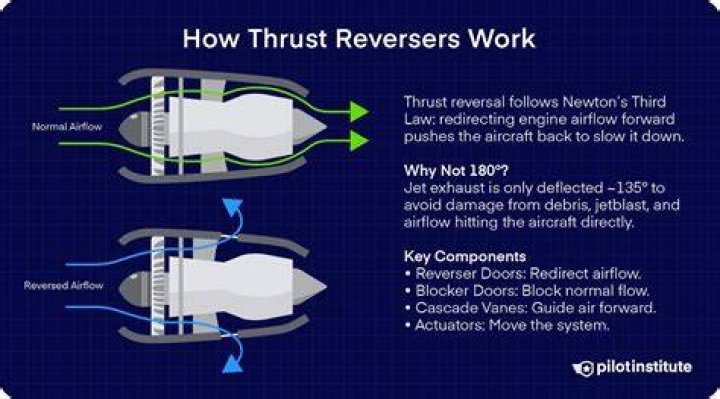
 Definition. Reverse thrust is thrust projected in the opposite direction to normal and is used to decelerate an aircraft after landing, in the event of a rejected take off or, in some limited cases, in flight.
Why is reverse thrust banned?
There are several reasons why using reverse thrust at the gate is not optimal for pushing back. As such, many aircraft today are banned from doing so. For example, the air blast around the aircraft can stir debris that may cause damage.
Is reverse thrust always used?
Reverse thrust is never needed. A reverse thrust is relatively complex thing that can easily fail and for this reason when deciding whether an aircraft can land at some runway, the calculations are done without assuming reverse thrust.
What and where do we use reverse thrust?
Airplanes can’t reverse direction in midair. Rather, reverse thrust is used primarily to assist pilots in decelerating their airplane prior to landing. When engaged, it changes the direction in which air comes out of the airplane’s engines, allowing the airplane to slow down in preparation of landing.
Can thrust reversers be deployed in flight?
They tend to make extremely steep descents more often (called a tactical descent/approach), so thrust reversers can be used in flight. I did some testing with the stock 747-400 in X-Plane. Deploying the thrust reverser only changes the force applied by the engine, but doesn’t seem to affect the air flow.
Can a plane reverse on its own?
no one ever does. Some aircraft can do a so-called ‘powerback’, but in most cases, airplanes either don’t have this technical capability. Most airplanes can taxi backwards by using reverse thrust. This entails directing the thrust produced by the plane’s jet engines forward, rather than backwards.
How effective is reverse thrust?
Effectiveness. The amount of thrust and power generated are proportional to the speed of the aircraft, making reverse thrust more effective at high speeds. For maximum effectiveness, it should be applied quickly after touchdown. If activated at low speeds, foreign object damage is possible.
Can you land without reverse thrust?
Landing without reverse thrusts is possible. Pilots are allowed to fly with deactivated or defect reverse thrusts because there are 2 other break systems which can stop the plane. Because of security, this break systems are necessary.
What is the purpose of afterburner?
Afterburning is a method of increasing the thrust of a jet engine for short periods of time in order to improve the aircraft take-off, climb, or combat performance.
How long do afterburners last?
In full afterburner at low altitudes, the F-16 can burn in excess of 64,000 pounds an hour. At full throttle, a U.S.-variant F-16 with maximum external fuel stores has about 20 minutes until it’s on emergency reserves (which would only last an extra minute or so at full afterburner).