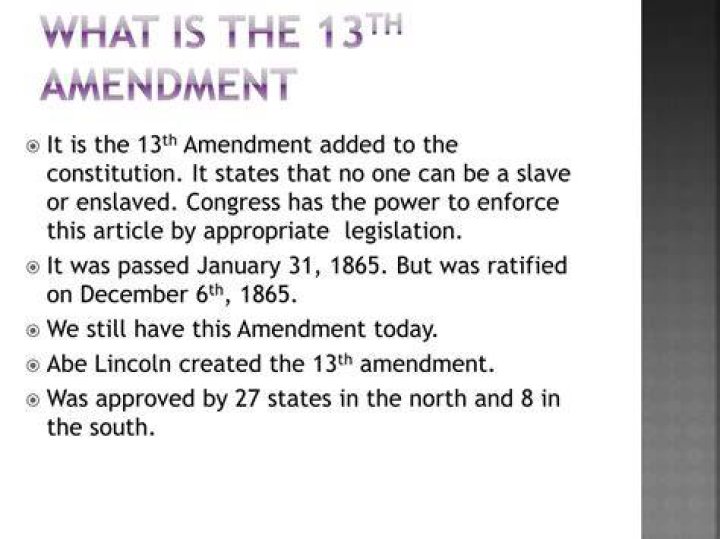
What is the 13th Amendment in simple terms for kids?
 Emma Newman
 The full text of the Thirteenth Amendment states: Neither slavery nor involuntary servitude, except as a punishment for crime whereof the party shall have been duly convicted, shall exist within the United States, or any place subject to their jurisdiction.
What is the 13th Amendment simple terms?
The 13th Amendment forever abolished slavery as an institution in all U.S. states and territories. In addition to banning slavery, the amendment outlawed the practice of involuntary servitude and peonage. Involuntary servitude or peonage occurs when a person is coerced to work in order to pay off debts.
Why is the 13th Amendment Important Kid friendly?
The Thirteenth Amendment to the United States Constitution was ratified on December 6, 1865. It’s one of the most famous amendments because it made slavery and involuntary servitude illegal in the United States. But the Thirteenth Amendment made their freedom permanent and freed those who were still in slavery.
What are examples of the 13th Amendment?
Thirteenth Amendment Although Congress abolished slavery in the District of Columbia in 1862, and President Abraham Lincoln’s Emancipation Proclamation ended the practice of slavery in rebellious states in 1863, at war’s end in 1865 the question of slavery had not been resolved at the national level.
Who does the 13th Amendment apply to?
The 13th amendment to the United States Constitution provides that “Neither slavery nor involuntary servitude, except as a punishment for crime whereof the party shall have been duly convicted, shall exist within the United States, or any place subject to their jurisdiction.”
Is there a loophole in the 13th amendment?
While the 13th Amendment — ratified in 1865 — banned slavery and involuntary servitude, it made an exception for those convicted of a crime. “The loophole in our constitution’s ban on slavery not only allowed slavery to continue, but launched an era of discrimination and mass incarceration that continues to this day.
Is the 13th amendment still used today?
Slavery is still constitutionally legal in the United States. It was mostly abolished after the 13th Amendment was ratified following the Civil War in 1865, but not completely. Lawmakers at the time left a certain population unprotected from the brutal, inhumane practice — those who commit crimes.
What is the Thirteenth Amendment?
The Thirteenth (13th) Amendment was the first of the three Reconstruction Period amendments approved after the Civil War. The 13th Amendment aimed to end slavery in the United States and it was passed on December 6, 1865.
What does the 13th Amendment say about involuntary servitude?
The 13th Amendment states: Section 1: Neither slavery nor involuntary servitude, except as a punishment for crime whereof the party shall have been duly convicted, shall exist within the United States, or any place subject to their jurisdiction. Section 2: Congress shall have power to enforce this article by appropriate legislation.
Did the 13th Amendment make slavery illegal everywhere in the United States?
Remember, that the emancipation proclamation only declared that slaves in the rebel states were free. The 13th amendment made slavery and involuntary servitude illegal everywhere in the United States.
What happened to the 13th Amendment in 1865?
The House approved the 13th Amendment proposal on January 31, 1865 with 119-56 votes. On February 1, 1865, Lincoln ordered to send the amendment for ratification. Lincoln was assassinated on April 14, 1865 and did not see the final ratification on December 6, 1865.


