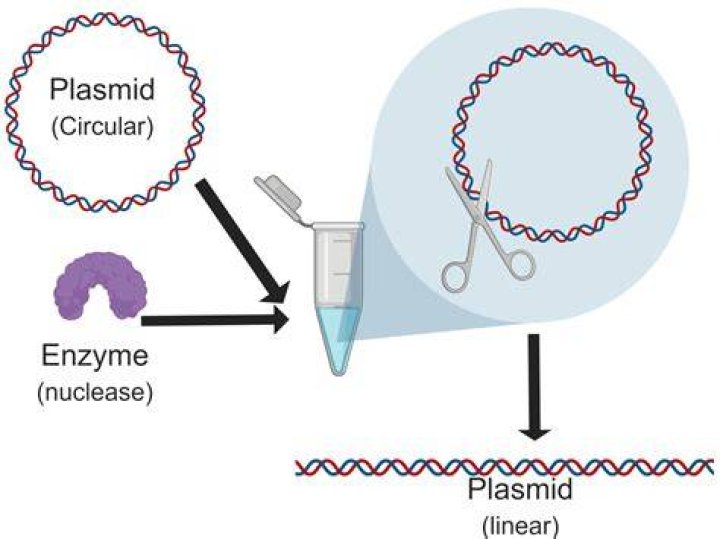
Why do we Linearize plasmids?
 James Austin
 If the plasmid DNA is intended for use as a PCR template, it is recommended to use it as a linear DNA. A circular plasmid mostly has a supercoiled conformation, where the target sequence is less accessible for primers and for polymerase. Linear DNA provides more reproducible and accurate results. …
What does linearized plasmid mean?
Linearization of circular plasmid DNA. Linearization of a circular DNA vector. A circular plasmid DNA molecule cut at one of the endonuclease restriction sites in its polylinker is transformed into a linear molecule with single-stranded “sticky ends.” In this case, digestion with EcoRI leaves ~~TTAA-5′ overhanging ends …
Does Confluency affect transfection?
Cell confluency and replication stage are factors intrinsically linked to each other that affect the efficiency of your transfection protocols. This is because cells that are actively dividing take up DNA more readily than stationary phase cells.
How do you stably transfect a cell line?
One of the most reliable ways to select cells that stably express transfected DNA is to include a selectable marker on the DNA construct used for transfection or on a separate vector that is co-transfected into the cell, and then apply the appropriate selective pressure to the cells after a short recovery period.
Do plasmids need to be linearized before PCR?
Intact plasmid DNA is supercoiled but PCR amplification works optimal with relaxed DNA. The difference in conformation between supercoiled and relaxed DNA can make a difference in the results of real-time PCR quantification. Therefore, to be on the safe side, it is better to linearize the plasmids routinely.
Can you PCR a circular plasmid?
We observed that PCR using circular plasmids as template gave 2.65-4.38 more of the threshold cycle number than did equimolar linear standards.
How do you know if a plasmid is linearized?
Linear Plasmid You can identify the linear DNA form on an agarose gel by comparing uncut plasmid DNA with a sample of the plasmid that has been linearized using a restriction enzyme.
What is confluency for transfection?
Confluency. As a general guideline, transfect cells at 40–80% confluency. Too few cells will cause the culture to grow poorly without cell-to-cell contact. Too many cells results in contact inhibition, making cells resistant to the uptake of foreign DNA.
How do you transfect a Crispr cell?
The procedure involves combining target cells, a buffer specific to each cell type, and gRNA/Cas9. These components are transferred to a cuvette or 16-well strip, which is then placed into a Nucleofector. An electric pulse with parameters pre-optimized for each cell type is then applied.
How long does hygromycin selection take?
Puromycin usually kills cells in 3 days, G418 in 7 days, hygromycin in 7 days and blasticidin in 5 days. Cells are often split before selection (e.g. 1:3). That’s because selection does not work if cells are too confluent! Cells should not be too sparse either; they would have a difficult time recovering.


